


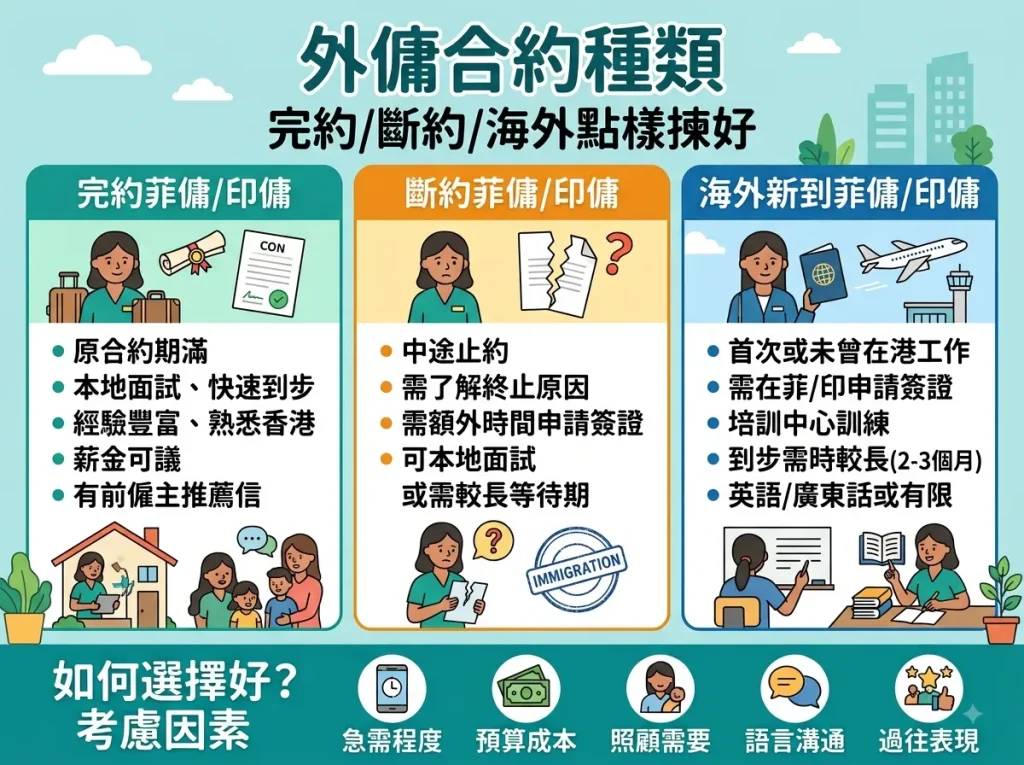
When hiring a domestic helper in Hong Kong, the two most common options are “domestic helpers whose contracts have expired” (those who have completed their contracts in Hong Kong and are currently in or have recently been in Hong Kong) and “overseas domestic helpers” (those who are still in their home countries or overseas and must undergo a medical examination, have their contracts notarized, and obtain a visa before coming to Hong Kong). Each type has its own advantages and limitations; the key is to choose the candidate who best fits your family’s schedule, budget, and specific job requirements.
Advantages of Hiring a Foreign Domestic Worker on a Fixed-Term Contract (Quick to Get Up to Speed, Short Adjustment Period)
- Quick Start Date: Foreign domestic helpers whose contracts have expired are already in Hong Kong, and the process of changing employers or renewing their contracts typically takes only about 1–2 months (depending on the specific case and the progress of the paperwork).
- Familiar with Life in Hong Kong: They are generally familiar with local household appliances, transportation, and lifestyles, which reduces the time needed to teach them from scratch.
- Verifiable work history: Employers can ask about the candidate’s actual job responsibilities during the interview and even check with previous employers to assess performance, which provides a more reliable reference.
- Well-developed communication skills: Many foreign domestic workers whose contracts have ended are accustomed to communicating in English or basic Cantonese, which is particularly beneficial for families that need assistance with doctor’s appointments, transportation, or communicating with schools.
Important Considerations for Foreign Domestic Workers Whose Contracts Have Expired (Matching Is Still Required)
- Completing a contract does not mean the employee is “all-around capable”: It simply means the previous contract has been fulfilled. You cannot determine whether the employee possesses the skills you need (such as cooking or specialized care) based solely on the fact that they “completed a contract.” Employers still need to confirm during the interview whether the actual daily job duties align with the employee’s skills.
- Agency and Cost Considerations: The agency fees or service charges for foreign domestic workers who have completed their contracts are typically higher; however, because they can start work quickly and the waiting costs are low, the overall costs remain competitive in some cases.
Advantages of Hiring Overseas Domestic Workers (Wide Selection, Can Be Trained from Scratch)
- Diverse Backgrounds: Overseas domestic workers may be traveling abroad for the first time, or they may have previously worked in other countries (such as Singapore, Taiwan, or the Middle East). Employers can choose candidates based on their preferences—whether they prefer those who are “more down-to-earth and obedient” or those with “international experience and strong adaptability.”
- Can Be Trained from Scratch: For those who want to train a domestic helper from the ground up according to their own lifestyle, a helper who is working abroad for the first time can be more easily molded into a caregiver who fits your household’s habits. [
- You may be able to find a more affordable option: While the service fees charged by some overseas agencies or providers in the country of origin may appear lower at first glance, you need to take other costs into account as well.
Restrictions on Foreign Domestic Workers (Time and Hidden Costs)
- The process takes a relatively long time: It involves contract notarization, medical examinations, visa approval, and flight arrangements. The entire process typically takes 2–3 months or longer, and may take even longer for certain countries or under specific circumstances. If you urgently need staff, overseas options are not time-efficient. Additional costs and opportunity costs: Aside from the seemingly lower agency fees, employers usually have to cover the costs of medical examinations, document certification, and airfare; moreover, during the waiting period, families may have to bear the opportunity costs associated with handling household chores themselves. The overall cost may not actually be cheaper.
Terminating a Contract or Resigning as a Foreign Domestic Worker: It’s Not Necessarily a Bad Thing, but Be Aware of Application Timelines and Visa Risks
In addition to domestic workers whose contracts have expired and those from overseas, there are also some domestic workers on the market whose contracts have been “terminated” or who have “resigned.” These candidates do not necessarily have work performance issues, but since their contracts were terminated early, employers should take extra care during interviews to understand the reasons for their departure, the actual circumstances of their previous employment, and whether there is supporting documentation and contact information for their former employer. Generally speaking, if a new visa is being applied for after an early contract termination, it is advisable to allow approximately two months for the entire process, starting from the time both the former and new employers have completed the termination procedures and signed the necessary documents with the new employer; The actual processing time depends on whether all documents are complete, whether any additional documents are required, and the processing pace of the Immigration Department. Additionally, if a foreign domestic worker has resigned or had their contract terminated twice within one year, the Immigration Department will scrutinize their case more closely. Records of such early terminations and the reasons behind them may affect the application for a new work visa and could even increase the risk of a visa denial.
How to Choose Based on Your Family Situation (Simple Guidelines)
- If you are in urgent need of staff (within 1–2 months) and are willing to pay a higher placement fee, give priority to foreign domestic workers whose contracts have ended.
- If you are willing to wait 2–3 months and are looking to train candidates from scratch or hire those who are traveling abroad for the first time, overseas domestic helpers may be worth considering.
- If you are looking for specific skills (cooking, infant care, or elder care): Whether the contract has ended or the position is overseas, the most important thing is to conduct a thorough interview to verify the actual daily job responsibilities, rather than focusing solely on whether the “contract has ended” or the “length of service.”
How to Filter in HelperLibrary (Practical Steps)
- Check the skill requirements: for example, experience with infants/toddlers, caregiving for the elderly, cooking skills, language skills (English, Cantonese).
- Filter by location and experience tags: Categorize candidates as “first-time travelers abroad,” “previously in Hong Kong,” “previously in other countries,” and more to quickly narrow down your pool of candidates. This information can be found in resumes or introductory videos.
- Bookmark candidates and conduct WhatsApp or video interviews: First, screen them using the app, then use a video interview to confirm the details of her daily work and her attitude, to avoid situations where “the resume looks good but the actual performance doesn’t match.”
Interview Checklist (Suggested Questions; Review Each One During the Interview)
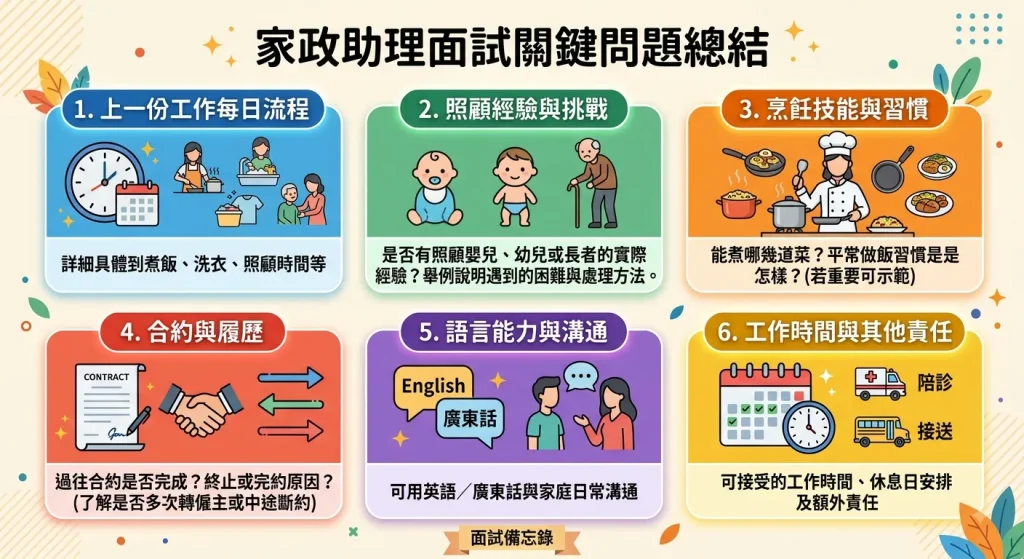
- What was your daily routine at your last job? (Be specific—including cooking, doing laundry, time spent caring for others, etc.)
- Do you have any practical experience caring for infants, young children, or the elderly? Can you give some examples of the challenges you’ve faced and how you handled them?
- What dishes can you cook? What is your usual cooking routine? (If cooking is important, please demonstrate or provide a short video.)
- Were previous contracts fulfilled? Why were they terminated or completed? (To determine whether the employee has changed employers multiple times or had contracts terminated prematurely)
- Language Skills and Communication Methods (Can you communicate with the family in English or Cantonese in daily life?)
- Frequently Asked Questions (FAQ) on Acceptable Work Hours, Schedule of Days Off, and Additional Responsibilities (e.g., Accompanying Patients to Appointments, Pick-up and Drop-off) (For Quick Reference on the Blog)
FAQ
1. What is a domestic worker with a fixed-term contract?
"Former foreign domestic workers" refer to individuals who have legally completed an employment contract in Hong Kong and have left their jobs; they are familiar with the living and working conditions in Hong Kong and typically adapt quickly to their new roles.
2. What is an overseas domestic worker?
"Overseas domestic workers" refer to foreign domestic workers who are currently in their home countries or abroad and are required to complete procedures such as medical examinations, contract notarization, and visa applications before departing for Hong Kong.
3. What is the difference in their start dates?
Domestic workers whose contracts have expired can usually start working within 1–2 months; for foreign domestic workers, it typically takes 2–3 months or even longer (depending on their nationality and the required procedures).
4. Which one is cheaper?
Unless you’re a direct-hire employer handling the paperwork yourself—which is much cheaper—the fees charged by recruitment agencies for placing workers at the end of their contracts are generally higher. While overseas agency fees may seem lower at first glance, when you factor in additional costs such as medical exams, paperwork, and airfare, as well as the opportunity cost during the waiting period, the overall cost isn’t necessarily cheaper.
Don’t just look at the label: During the interview, ask specific questions about “what they actually do every day” before making a decision. If you urgently need help, prioritize hiring foreign domestic workers whose contracts have just ended to minimize the gap in coverage. If you want to train a helper according to your own methods or prefer a novice with a simple, uncomplicated mindset, you may consider candidates who are working abroad for the first time, but be sure to allow enough time and make the necessary arrangements for the paperwork.
There is no one-size-fits-all answer when it comes to choosing the right type of foreign domestic worker, The key is to prioritize these three factors—“time requirements, budget, and essential skills”—and then use HelperLibrary’s filtering tools and video interviews to confirm the details. This approach will minimize the risk of a poor match and help you find the helper who’s the best fit for your family.