"What should domestic workers eat?" If a domestic worker wants coffee, milk tea, or snacks, should the employer provide them? It may sound like a minor issue, but it is actually a practical problem that many Hong Kong families face every day. Some families prefer to eat meals with their domestic workers, while some domestic workers have religious or dietary restrictions. Other employers choose to provide a meal allowance so that their domestic workers can make their own arrangements.
This blog post will begin by discussing Hong Kong’s legal requirements, then share how employers can handle common situations such as organic foods, picky eating, and religious dietary restrictions, to help employers establish a fair and comfortable living arrangement that avoids conflicts over “mealtimes.”
I. What Employers Need to Know: Free Meals or Meal Allowances for Foreign Domestic Workers
According to Hong Kong’s “Standard Employment Contract” (ID 407), employers must provide foreign domestic workers withFree Meals, or payMeal AllowanceInstead.
The current meal allowance for foreign domestic workers isAt least HK$$1,236 per month, applicable when free meals are not provided for the 2026–2027 school year. This allowance isAdditional Payment...must not be included in the foreign domestic worker's wages, nor may it be deducted from their wages.
| Arrangements | Contents | Suitable Situations |
| Provides free meals | The employer shall provide sufficient and appropriate daily meals, including meals at home on days off and holidays. | Families are in the habit of eating meals together or prefer to do their grocery shopping as a group |
| Payment of Meal Allowances | Pay at least HK$$1,236 per month so that the foreign domestic worker can buy their own food | Foreign domestic workers have special dietary needs, or there are significant differences in the family’s eating habits |
💡 Important Reminder: Even if a domestic worker is responsible for cooking, that does not mean that “just because she cooks for you, her meals are taken care of.” Employers must still ensure that she has sufficient, free, and appropriate food.
II. What constitutes a reasonable arrangement for employers when providing meals to foreign domestic workers?
The law does not specify in detail what foods must be provided, but meals shouldPlentiful, free, and suitable for daily consumption by domestic workers. In fact, the most common and simplest approach is to have the domestic worker eat meals with the family or to prepare similar meals for her.
You may want to keep the following principles in mind:
- Plenty to go around: It’s not about “eating whatever leftovers are available,” but rather ensuring there’s enough rice, vegetables, protein, and soup. One employer once provided only soup scraps for the domestic worker to eat every day. While this isn’t impossible, the result was that the domestic worker resigned—and it wasn’t worth the trouble.
- Food on the Table Every Meal: Including days off, public holidays, and days when the domestic worker stays at home.
- Respecting Basic Nutritional Needs: For example, if a foreign domestic worker does not eat pork, requires halal food, is vegetarian, or has food sensitivities, you should try to provide alternative meals.
- Avoid offering only snacks or instant noodles: It's okay occasionally, but it shouldn't be a regular meal.
- You should also make plans for eating out: If a family goes out to eat, they should arrange a meal for the domestic worker or discuss in advance how to handle the situation.
III. Fun Scenario 1: Your Foreign Domestic Worker Asks for Organic Vegetables—What Should You Do?
Some employers have encountered this situation: A foreign domestic worker says, “My previous employer always bought organic food. Can I continue to do so?”
First of all, don’t immediately assume they’re “asking for the moon.” If a foreign domestic worker encounters an employer who only eats organic food on their first job, they may not be familiar with how typical households operate. Employers should explain during the interview that different families have different habits and see how the worker reacts.
IV. Interesting Scenario 2: A Foreign Domestic Worker Who “Eats Only Seafood”—Should This Be a Screening Criterion During the Interview?
Some foreign domestic workers may say, “I don’t eat beef or pork; I can only eat seafood.” If she will eat almost nothing but seafood, employers should be cautious, as this could affect daily grocery costs, meal preparation, and even the family’s eating habits.
Here are some questions you can ask during an interview
Don't just ask, "Are there any foods you don't eat?" Instead, ask more specific questions, such as:
- What do you usually eat for breakfast, lunch, and dinner?
- Do you have any food allergies, religious dietary restrictions, or foods you simply don't eat?
- Do you ever buy extra food on your own? How much do you spend on it, roughly, each week?
- If you don't finish your dinner and there are leftovers, would you eat them the next day?
EmployerWatch for these signs
- Reasonable Circumstances: Not eating pork, following a vegetarian diet, having seafood allergies, or requiring halal meals—these needs can usually be accommodated through communication and by providing alternative food options.
- Situations to Be Aware Of: Willing to eat only certain types of expensive foods, refusing most home-cooked meals, expecting the employer to provide specific ingredients every day, or strongly resisting the idea of “buying them on their own.”
- A Better Attitude: Be willing to eat home-cooked meals, be willing to supplement your diet with foods you like, and be able to clearly explain your dietary needs—rather than placing all responsibility for your diet on your employer.
💡 Summary: Discussing dietary preferences during an interview isn’t about being picky—it’s about avoiding dissatisfaction related to “meals” after starting the job. The sooner dietary preferences are made clear, the smoother the collaboration will be.
V. Other Common Dietary Situations and How to Handle Them
1. The foreign domestic worker is Muslim and does not eat pork.
This is a common dietary need that should be respected. Employers may provide alternative foods such as chicken, fish, eggs, vegetables, and legumes, or allow her to prepare some of her own meals. If the household frequently prepares dishes containing pork, employers may consider using separate cooking utensils and tableware, or opt to provide a meal allowance.gma
2. Foreign domestic workers want to cook for themselves
If a foreign domestic worker wishes to cook dishes from her home country, this is generally a good thing, as it helps her adapt to life in Hong Kong. Employers can provide basic kitchen utensils, rice, oil, salt, etc., or work with her to determine which ingredients the employer will provide and which she will purchase herself. Otherwise, provide a food allowance $1236; otherwise, misunderstandings regarding food costs may arise.
3. The foreign domestic worker wants to eat with the children
If the foreign domestic worker is responsible for feeding the children, eating with them can sometimes encourage the children to eat. However, it should be made clear in advance that she must still have her own meals and cannot eat only the children’s leftovers.
4. Foreign domestic workers like snacks, bubble tea, or coffee.
These are a matter of personal preference, and employers are under no obligation to provide them on a long-term basis. If a domestic worker would like coffee, milk tea, or snacks, you can suggest that she purchase them herself; if the family chooses to share, it is a gesture of goodwill rather than a responsibility.
VI.A Clear Breakdown: Which Foods at Home Are Safe to Eat?
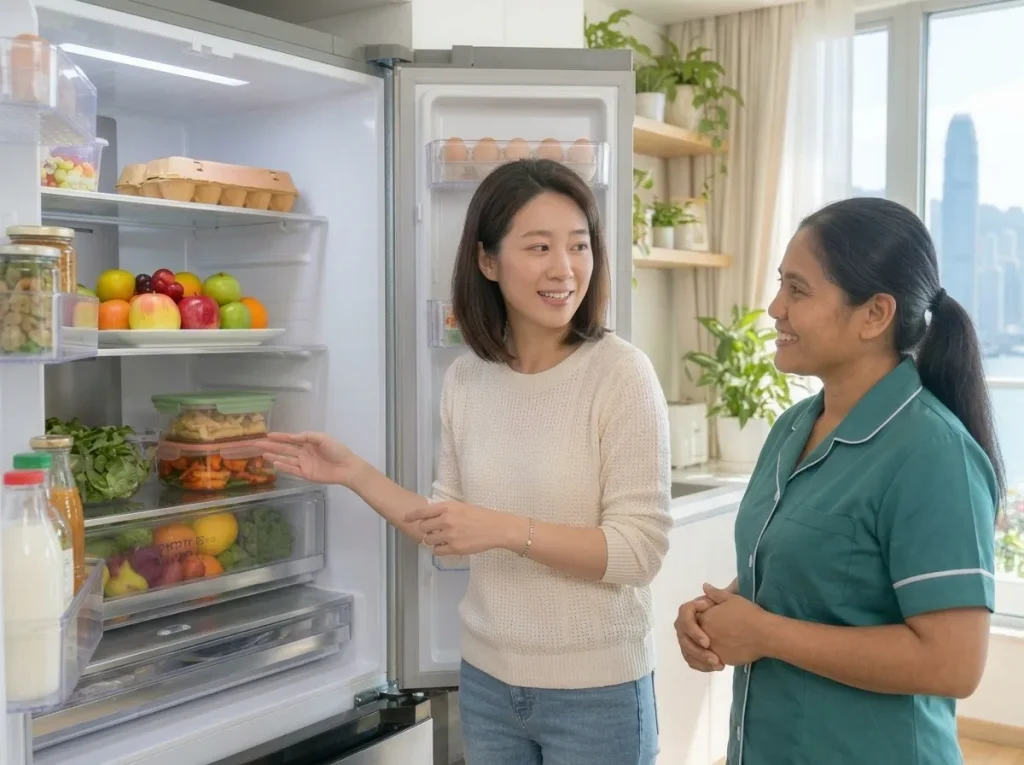
In addition to arranging daily meals for the domestic worker, employers should also clearly inform her:Which foods at home are for her to eat, and which are for the family or for special occasions? For example, frozen shrimp, Wagyu beef, expensive seafood, children’s formula, or snacks stored in the freezer may not be items that domestic helpers can help themselves to.
One employer once discovered that a foreign domestic worker had cooked and eaten the expensive shrimp from the refrigerator because she thought, “I can eat anything in this house.” This kind of situation is often not intentional, but rather the result of a lack of clear communication between both parties. Employers can provide a simple explanation upon hiring, such as: “You may use the vegetables, eggs, and white rice on the bottom shelf of the refrigerator; for frozen seafood, expensive ingredients, and the children’s food, please ask me first.” A simple rule like this can prevent misunderstandings and put the domestic helper’s mind at ease.
FAQ
Question 1: Can an employer pay a monthly meal allowance of HK$$1,236 without providing meals?
Yes. If an employer chooses not to provide free meals, this must be specified in the contract, and the employer must pay a meal allowance of no less than HK$$1,236 per month. This allowance must be paid in addition to wages and may not be deducted from wages.
Question 2: If a foreign domestic worker requests organic food, is the employer required to comply?
That is not necessary. The employer is responsible for providing free meals or paying the statutory meal allowance; organic food is a matter of personal preference, so domestic workers may purchase it on their own, or the employer may decide whether to provide it based on their budget.
Question 3: Our foreign domestic worker only wants to eat seafood. Should we hire her?
It’s not necessarily out of the question to hire her, but during the interview, you should gain a thorough understanding of her daily eating habits, the range of foods she’s willing to eat, and whether she’s willing to purchase additional food on her own. If her requests would significantly increase household expenses or disrupt your daily cooking routine, you’ll need to carefully consider whether she’s a good fit.
Question 4: Can the meal allowance be included in a foreign domestic worker's wages?
No. The meal allowance is an additional payment separate from the minimum wage and cannot be used to offset wages.
Conclusion
Meal arrangements for domestic workers may seem like a trivial matter—just the day-to-day details of food and daily necessities—but they actually best reflect the level of respect and communication between employers and domestic workers. Whether you choose to eat together, prepare separate meals, or provide a meal allowance, the most important thing is:Speak clearly, write clearly, and be understanding of one another within reason.
When "mealtimes" are no longer a source of daily friction, domestic workers will feel more at ease on the job, and the family will feel more relaxed and comfortable.