
Many Hong Kong families hope that after hiring a domestic helper, the helper will also take their children to school, accompany elderly family members to medical appointments, or go grocery shopping at the market. However, the “Standard Employment Contract” for foreign domestic workers does not, in principle, include driving duties; if such duties are indeed necessary, employers must first apply to the Immigration Department.Special PermitDriving Duty...only then may a foreign domestic worker be assigned to perform limited driving tasks related to household chores.
I. Which employers are eligible?
If you wish to have a domestic helper drive, you must ensure that the driver holds a valid Hong Kong driver’s license. Employers must also prove that the driving isActual needs incidental to or arising from domestic work...rather than using domestic workers as full-time drivers.
Driving-related work permitted by the Immigration Department must be related to housework, cooking, caring for the elderly, or caring for infants or children—for example, driving children to and from school, taking the elderly to medical appointments, or going to the market to buy groceries.
The following activities are not eligible for approval:
- Daily transportation for employers to and from work
- Transportation of Commercial Goods
- Provide driving services to other families, friends, relatives, or companies
II. How to Use HelperLibrary Looking for the right driver?
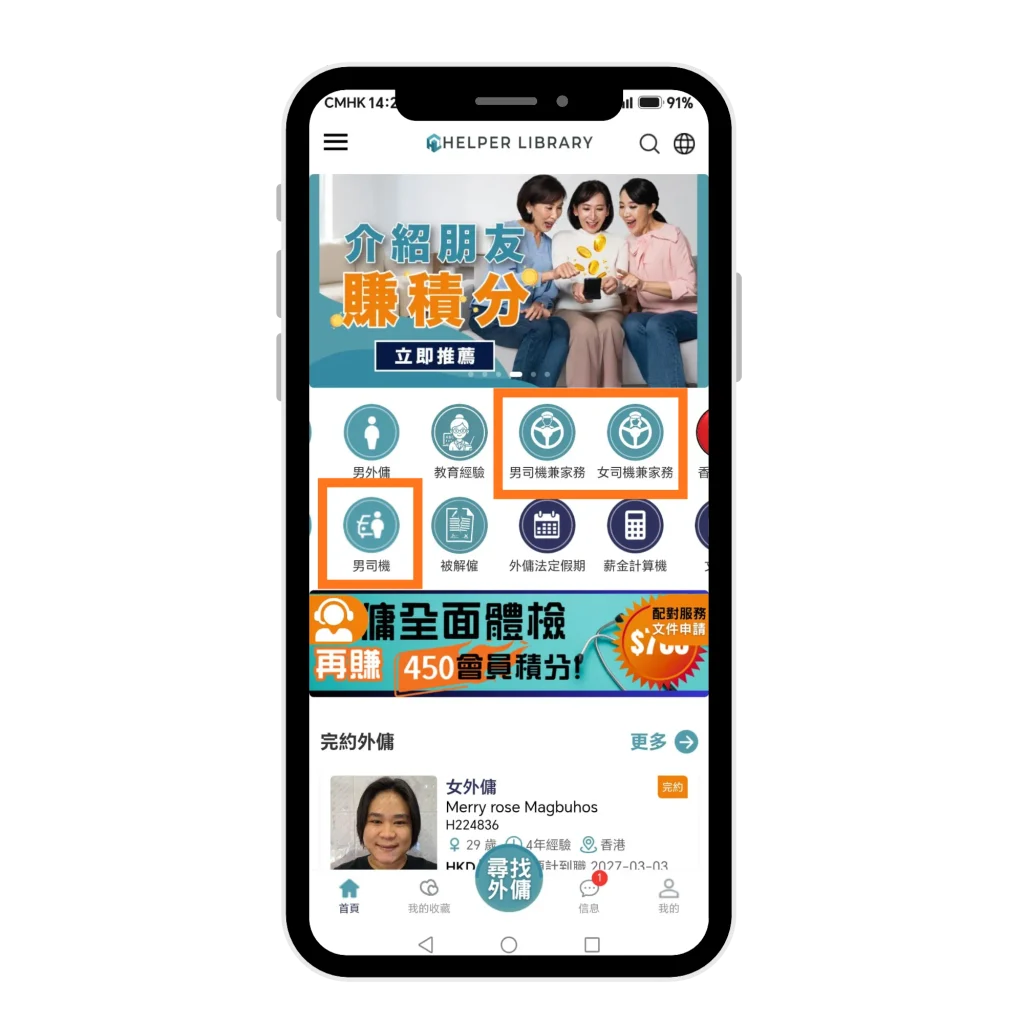
On the HelperLibrary platform, employers can filter for suitable candidates from two categories of driver profiles based on their family’s needs:
| Resume Type | Great for families | Main Job Responsibilities |
| Driver and Housekeeper | I hope one person can handle both driving and daily household chores. | Transporting children or seniors, grocery shopping, cooking, cleaning, laundry, and other household chores |
| Driver Only | Driving tasks that are more frequent or require greater concentration | Primarily responsible for pickups and drop-offs, vehicle cleaning, route planning, and related travel arrangements |
If a family needs to take children to and from school or accompany elderly family members to medical appointments, and would also like to have some household chores taken care of, they may want to consider “Driver and Housekeeper". If your family travels frequently, or if you want the driver to focus on driving safety, vehicle maintenance, and route planning, you may want to consider "Driver Only」。
Generally speaking, a driver’s monthly salary ranges from approximately HK$7,500 to HK$20,000. Actual pay may vary depending on driving experience, hours worked, whether the driver also handles household chores, whether the job involves transporting children or the elderly, and the family’s requirements regarding language skills, familiarity with routes, and the scope of services.
III. What Are the Advantages of Female Drivers?
Female and male drivers each have their own strengths, and employers should not judge driving ability based solely on gender. However, for families that need to care for children or the elderly, or that value attentive communication, female drivers may offer the following benefits:
- It’s easier to build trust with children, especially when getting in and out of the car, while waiting, and during sudden emotional outbursts.
- Suitable for those who need to balance household chores, especially for the role of “driver and housekeeper.”
- Female passengers or seniors may feel safer this way.
However, gender should not be the sole screening criterion. Employers should still use driving records, driving experience in Hong Kong, safety awareness, ability to handle emergencies, communication skills, and willingness to share household responsibilities as the primary evaluation criteria.
IV. How Do I Apply for a Driving Position?
Some employers hire foreign domestic helpers who do not have a Hong Kong driver’s license but only have driving experience in their home country. Once the helper arrives in Hong Kong and successfully obtains a Hong Kong driver’s license, the employer must notify the Immigration Department to add “driving” to the helper’s job duties before the helper can officially drive for the household. Employers cannot simply add “driving” to the domestic helper’s “job description” and consider the arrangement complete. According to the Standard Employment Contract, a domestic helper’s duties do not, in principle, include driving any vehicle, unless the Director of Immigration has approved the relevant driving duties in accordance with Clause 15(d) of the contract. The procedure is generally quite complex,Employers are advised to use recruitment agencies.
If an employer wishes to have a foreign domestic worker drive, the following steps should be followed:
- Confirm Actual Needs: Clearly state the reasons why the foreign domestic worker needs to drive, such as taking children to and from school, accompanying elderly family members to medical appointments, or purchasing groceries for the family.
- Verifying the Eligibility of Foreign Domestic Workers: Foreign domestic workers must hold a valid Hong Kong driver's license; international driver's licenses, temporary driver's licenses, and provisional driver's licenses do not meet the application requirements.
- Fill out the application form: Employers and foreign domestic workers must jointly complete the Immigration Department’s “Application Form for Special Permission for Foreign Domestic Workers to Perform Driving Duties” (ID 934A) and submit the supplementary document “Schedule of Accommodation and Household Duties.”
- Provide Vehicle Information: When applying, you must provide details such as the vehicle's ownership, type, and license plate number.
- Arrange Insurance: Employers must bear the full cost of insurance and may not deduct the relevant premiums from the domestic workers' wages.
- Arrange for a driver only after obtaining approval: Employers should not require foreign domestic workers to drive before obtaining a special permit.
When submitting an application, employers should clearly specify the purpose of driving, the schedule and frequency, the routes and destinations, vehicle details, the domestic worker’s driving experience, as well as insurance and accident handling arrangements. A clear and specific application makes it easier for the Immigration Department to understand that the driving duties are indeed an incidental requirement of domestic work, rather than a full-time driving job.
V. How do I check my driving record?
Since Hong Kong does not have a publicly available “database of minor traffic accidents or insurance claims,” employers should comprehensively evaluate a driver’s past performance by reviewing official documents, conducting interviews, and arranging test drives.
| Documents | Verifiable Information | Application Procedures and Fees |
| Certificate of Traffic Convictions and Record of Driving Infraction Points | Records of traffic violation convictions, payment of fixed-amount fines, and driving violation point records. | Drivers may apply to the Central Traffic Offenses Prosecution Unit of the Hong Kong Police Force; the fee is HK$61. |
| Certificate of Driver's License Details | The date of issuance of the Hong Kong driver's license, the categories of vehicles the holder is authorized to drive, and whether the holder has ever had their driving privileges revoked. | You may apply online through the Hong Kong Government's "One-Stop Portal" or submit Form TD 320; the fee is HK$160 per application. After submitting your online application and completing payment, you can download the certificate immediately. |
If a driver has registered for “Smart Convenience,” they can use the Transport Department’s “License Easy” electronic licensing platform to instantly display their driver’s license, the vehicle categories they are authorized to drive, the license expiration date, and their traffic violation point record.
During an interview, an employer may ask in a neutral and specific manner: “Have you ever been involved in a traffic accident? How did you handle the situation at the time?” “Have you ever received points on your license or been fined for a traffic violation?” “Can you provide a Certificate of Traffic Convictions and a Certificate of Driver’s License Details?” If a driver is unwilling to provide official documentation or is evasive about their driving record, the employer should be on high alert.
VI. How Can You Determine If a Foreign Domestic Worker Is Suitable for Driving?
Even if a foreign domestic worker already has a Hong Kong driver’s license, this does not necessarily mean they are familiar with Hong Kong’s roads or the vehicles at their employer’s home, or that they can safely care for children and the elderly. Employers should arrange for a systematic evaluation and a trial period before officially assigning driving duties.
1. Verify Identification and Insurance
First, confirm that the foreign domestic worker holds a valid Hong Kong driver’s license and that the vehicle has valid third-party insurance and other required coverage. The employer is responsible for the insurance costs and must not require the foreign domestic worker to pay for them or deduct the amount from their wages.
2. Take a test drive along the route
During off-peak hours, have the foreign domestic worker first drive a familiar and simple route, such as from the residence to a nearby supermarket or park. The employer should sit in the passenger seat and observe, rather than having the driver transport children or the elderly right from the start.
The following symptoms may be observed:
- Can you maintain a reasonable speed, keep a safe following distance, and use your turn signals correctly?
- Are you aware of blind spots, pedestrians, bicycles, and motorcycles?
- Do you know how to ask questions in advance to understand the situation?
- Do you get confused or panicked when encountering unfamiliar road conditions?
3. Simulating Real-Life Household Needs
If the foreign domestic worker is primarily responsible for picking up and dropping off children, you should first arrange a “dry run”—a simulated trip with an empty car or accompanied only by an adult family member—and then gradually begin arranging actual pickups and drop-offs. During the test, pay attention to the following:
- Do you know how to use a child safety seat or booster seat correctly?
- Do you make sure the children have their seatbelts fastened before driving?
- Do you know how to ensure children's safety when getting in and out of the car?
VII. How to Assess Mental Resilience and Adaptability?
The focus of the test is not to require foreign domestic workers to “know everything,” but rather to confirm that they can remain calm under pressure, prioritize safety, and know how to seek help promptly. The Hong Kong Transport Department also reminds drivers to avoid driving while fatigued, stay focused, and manage stress appropriately.
1. Understanding Stress Responses During Interviews
You can ask situational questions to observe whether the foreign domestic worker can analyze the situation calmly, prioritize safety, and is willing to ask for help.
Let's put it this way:
- "If your car breaks down while you're picking up your child, what would you do?"
- "If a child is crying, vomiting, or feeling unwell in the car, how would you handle it?"
- "If you were involved in a traffic accident, what would you do first?"
- "If you're unfamiliar with the route or your GPS gives you the wrong directions, what would you do?"
- "What would you do if it rained, there was a traffic jam, or you couldn't make it in time to pick up your child?"
- "If you're tired, feeling unwell, or in a bad mood, would you still drive?"
An ideal response should include “first ensure safety, pull over, notify your employer, and seek assistance,” rather than simply emphasizing “I’ll get there as soon as possible.” In the event of an accident, drivers should first ensure the scene is safe, turn on their hazard lights, and call 999 if necessary.
2. Observe how composed they are during the test drive
| Key Points to Observe | A more appropriate way to express this | Please note |
| Speed Control | Drive at a steady speed and maintain a safe following distance | Sudden acceleration or braking due to nervousness |
| Concentration | Focus on Road Surfaces and Navigation | Becoming flustered due to interference from other vehicles or passengers |
| Safe Operation | Use Turn Signal Lights Properly and Be Aware of Blind Spots | Blind spots, turn signals, or safe following distances |
| Willingness to Seek Help | Be willing to say, “I’m not familiar with this road; please let me pull over first to check.” | Forced to keep driving, too afraid to ask questions |
| Self-Awareness | If you feel tired or unwell, proactively let others know that you are not fit to drive. | Insisting that "it'll definitely be fine" and driving despite the circumstances |
Fatigue, drowsiness, or the effects of medication can impair your vision, reaction time, and judgment; before driving, you should also plan your route, inspect your vehicle, and adjust your seat and mirrors.
3. Conduct a simple scenario drill
| Scenario | Key Response Measures |
| The car broke down | Move to a safe location and turn on your hazard lights; if you cannot safely exit the roadway, stay in the vehicle, fasten your seatbelt, and call for help as soon as possible. |
| Minor Traffic Accident | Pull over, ensure everyone is safe, turn on your hazard lights, and notify your employer and the police; if anyone is injured, call for help immediately. |
| Child Feeling Unwell | Park safely first, then attend to the matter; do not try to handle it while driving. |
| Unfamiliar with the route | Slow down or pull over to a safe location, and use your navigation system or call your employer to confirm. |
| Bad weather | Slow down and increase your following distance; if it is unsafe, reschedule or make alternative transportation arrangements. |
| Fatigue or discomfort | Proactively inform your employer; you should not drive if you feel unwell. |
VIII. Driving Arrangements After Hiring
Even after obtaining special permission, employers should still include driving duties in the daily household schedule and review them regularly. Recommendations include:
- Make sure children and seniors are properly secured in car seats or with seat belts.
- Foreign domestic workers are prohibited from using cell phones while driving.
- Regularly review your frequently traveled routes, parking locations, and emergency contact information.
FAQ
Question 1: If a foreign domestic worker has a Hong Kong driver's license, can they drive right away?
No. Even if a foreign domestic helper holds a valid Hong Kong driver’s license, the employer must first apply to the Immigration Department for special permission before allowing the helper to perform driving duties related to household chores.
Question 2: Can I ask my domestic helper to drive me to and from work?
No. Driving the employer to and from work constitutes the duties of a private driver and does not fall under driving tasks incidental to or arising from household duties.
Question 3: Can an employer access a driver's traffic record on their own?
No. For privacy protection, employers should require the driver to apply for the relevant certificate directly from the Hong Kong Police Force or the Transport Department, or have the driver sign a letter of authorization authorizing the employer to handle the matter on their behalf.
Conclusion
Hiring a domestic worker as a driver can be convenient for families with young children, elderly members, or those who need help with daily shopping—provided that the arrangement is legal, safe, and clearly defined. Employers should first confirm their eligibility and then apply for a special permit from the Immigration Department; at the same time, they can use the “Driver and Housekeeper” and “Driver Only” resume categories on HelperLibrary to screen for suitable candidates based on their family’s needs.
Whether choosing a female or male driver, employers should use driving records, safety awareness, ability to handle emergencies, and communication skills as the primary evaluation criteria, and verify the candidate’s suitability for the driving position through official documents, test drives along the route, and scenario-based drills. When driving arrangements, insurance liability, safety rules, and emergency response procedures are clearly defined, foreign domestic workers will feel more confident, and family members will be safer and more at ease.